Skip to content


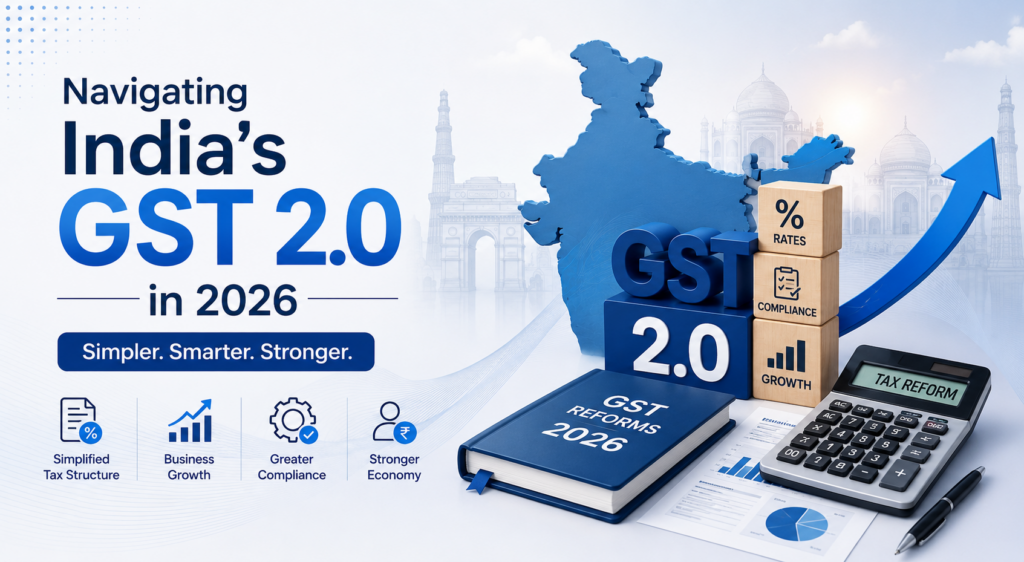
Navigating India's GST 2.0 in 2026: Simplified Slabs, Stricter Compliance, and Process Reforms
The year 2026 has officially ushered in a new era for indirect taxation in India, commonly referred to as "GST 2.0". After nine years of continuous evolution, the Goods and Services Tax (GST) framework is no longer just about understanding tax rates; it is now heavily focused on technological enforcement, real-time data capturing, and zero-tolerance compliance. From major shifts in tax slabs to mandatory system-driven checks, the updates implemented throughout early 2026 will directly dictate how businesses file returns, claim tax credits, and manage their daily cash flows.This overhaul is not just an administrative update; it is a fundamental shift towards a technology-driven, zero-evasion filing experience. By consolidating the legacy slab structures and enforcing smart, dynamic portal validations, the tax department aims to drastically reduce compliance loopholes, minimize fraudulent claims, and make the monthly tax filing process highly reliant on automation. Whether you are a small enterprise, a large-scale manufacturer, an active service provider, or a chartered accountant managing client portfolios, understanding this new GST architecture is essential for smooth, hassle-free business operations.
Major Changes at a Glance
A. The Simplified Rate Structure
- ✓Abolition of the 12% Slab: The most anticipated change that took full effect this year is the rationalization of GST rates. The traditional four-slab structure has been consolidated, and the 12% tax slab has been completely abolished.
- ✓Shift to 5% and 18%: Items that previously fell under the 12% category have now been dynamically moved to either the 5% slab (for essential goods) or the 18% slab (for standard products).
- ✓Luxury Goods Remain at 40%: A higher 40% rate continues to apply to luxury and "sin" goods, such as specific tobacco products and high-end cars, ensuring revenue balance while minimizing classification disputes.
- ✓Reduced Classification Clutter: By streamlining the slabs, the visual and operational clutter of determining correct HSN codes is significantly reduced, saving time and preventing legal friction.
B. Zero Mismatch Policy and Strict ITC Validation
- Invoice Management System (IMS): The portal now enforces a strict "Zero Mismatch Policy." If there is any discrepancy between invoices reported by a supplier in GSTR-1 and what a buyer claims in GSTR-3B, the portal automatically blocks the buyer's return.
- Strict Ledger Validations: Filings will be hard-blocked if a business has an insufficient electronic credit ledger balance or pending reverse charge mechanism (RCM) dues that have not been actively cleared.
- Auto-Reconciliation Integration: The new system actively cross-checks declared credits against data available with the IT department, instantly flagging discrepancies before final submission to prevent future scrutiny notices.
C. Tighter Timelines for E-Invoicing and E-Way Bills
- Lowered Thresholds: As of April 2026, e-invoicing has become mandatory for any business with an Aggregate Annual Turnover (AATO) exceeding ₹5 crore, ensuring maximum formalization of MSMEs.
- 30-Day Reporting Limit: For larger businesses, a strict 30-day time limit has been imposed for reporting e-invoices (IRN generation). Invoices reported after this window are instantly considered invalid for Input Tax Credit (ITC) purposes.
- 180-Day E-Way Bill Rule: An e-way bill can now only be generated against base documents dated within the preceding 180 days. Stale invoices are systematically blocked by portal controls.
Decoding the "Statutory Time Bar" Architecture
The underlying philosophy of the 2026 reforms is a shift from a "reactive" compliance approach to a "real-time" approach. In the past, businesses could often file belated returns years after the deadline by simply paying a late fee. This created massive backlogs and reconciliation nightmares for the government.Under the new architecture, a rigid 3-year statutory time bar has been hard-coded into the GST portal. From 2026 onwards, the portal permanently blocks the filing or modification of any returns (including GSTR-1, GSTR-3B, and GSTR-9) that are older than three years from their original due date. This hard cutoff means businesses with unfiled or disputed returns from older financial years can no longer resolve them through the standard portal mechanism. This design not only accelerates the closing of financial books but also drastically reduces the server load by preventing endless retroactive amendments.
What Businesses Should Do?
- Upgrade ERP Systems Early: Because the new framework relies heavily on real-time data, it is absolutely critical to configure your ERP or accounting software to automate IRN generation within the strict 30-day window.
- Monitor Vendor Compliance Carefully: Do not blindly assume your suppliers are filing correctly. With the Zero Mismatch Policy, a defaulting vendor will instantly block your ITC. Implement strict vendor payment holds until their GSTR-1 is accurately filed.
- Audit RCM and Ledgers: Ensure all your active ledger balances are reconciled and Reverse Charge Mechanism (RCM) dues are paid promptly to avoid system-level blocks during your monthly GSTR-3B filing.
- Consult Your CA for Inverted Duty Claims: If your sector suffers from the inverted duty structure (IDS), consult a financial professional to leverage the newly rolled-out 90% provisional refund mechanisms approved in the recent 57th GST Council meeting.
Big Picture
The continuous evolution of GST regulations in 2026 is a landmark step towards global best practices in tax administration. By adopting dynamic validations and enforcing strict real-time reporting, the government is actively removing the evasion loopholes associated with indirect tax filing. This reform pairs perfectly with the massive surge in digital infrastructure, collectively driving a dual agenda: unparalleled transparency and economic formalization. While the initial transition requires businesses to modernize their internal workflows, the long-term result is a faster, cleaner, and highly transparent tax compliance ecosystem that benefits both the honest taxpayer and the state economy.✓ Takeaway: Embrace the process change. The era of casual, delayed GST filings is permanently over. Businesses must focus on maintaining flawless, real-time financial records, holding vendors accountable, and either utilizing smart ERP tools or partnering with expert GST compliance services to file returns accurately and avoid portal-level blocks.
Latest Blog